Nova Scotia has the highest rate per capita of human trafficking in the country, according to new data shared by Statistics Canada.
The report published on Dec. 8 includes numbers from 2024, showcasing over a 10-year period that the average annual rate for Canada is 1.2 incidents per 100,000 people. In Nova Scotia, it is 4.1 incidents per 100,000.
In Ontario, the country’s most populous province, the rates were 2.0 per 100,000, still less than half of Nova Scotia.
These numbers are incidents reported to police, and Sgt. Jeff MacFarlane, manager of the RCMP human trafficking unit, said they can be misleading.
“It’s important to remember that it is per capita. It doesn’t mean we have the most instances anywhere,” he said. “We’re having more reports coming into the police, and we like to think a lot of that comes down to the fact that we’ve had a dedicated unit here for the province for coming up on seven years.”
The StatCan report notes that police-reported human trafficking has declined in Nova Scotia by 44 per cent since its peak in 2020. However, it details that there were more Immigration and Refugee Protection Act (IRPA) than Criminal Code offences reported by police in the province, a ratio that is 60 versus 40 per cent.
This, the report reads, “has not been observed since 2017 when 66 per of Nova Scotia’s human trafficking incidents were IRPA offences.”
MacFarlane said that the issue can be a combination of the province’s borders and its being a port city.
“The truth is, people end up in exploitation through human trafficking often because that trafficker is finding something that they’re missing and they’re looking to exploit that,” he said.
It is a “misnomer” that people are being grabbed and kidnapped off the street and are taken to a foreign country to be abused, MacFarlane explained.
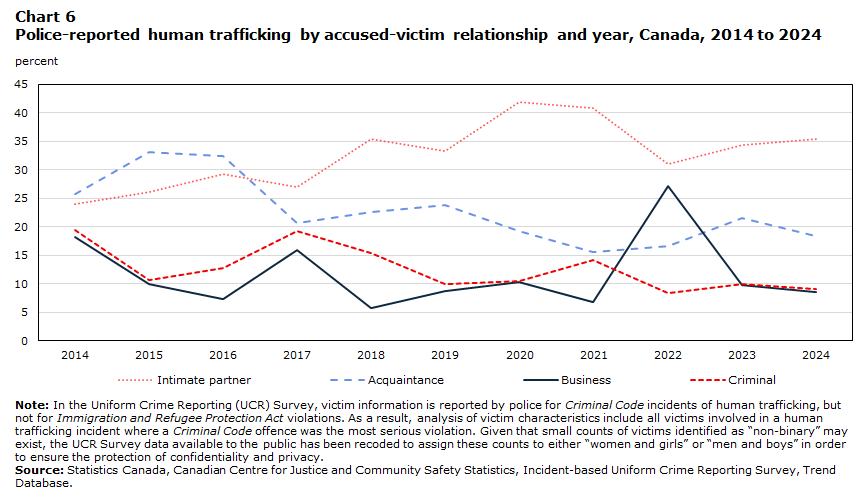
“The vast majority of these instances of human trafficking are for the purpose of sex, it’s usually caused by someone whom the person knows, and very often it’s actually someone that they’re in an intimate relationship with,” he said.
Sex trafficking and sex work are “often conflated,” the report notes, but the former is when people are forced, deceived or coerced into participating in sexual activities without true consent.
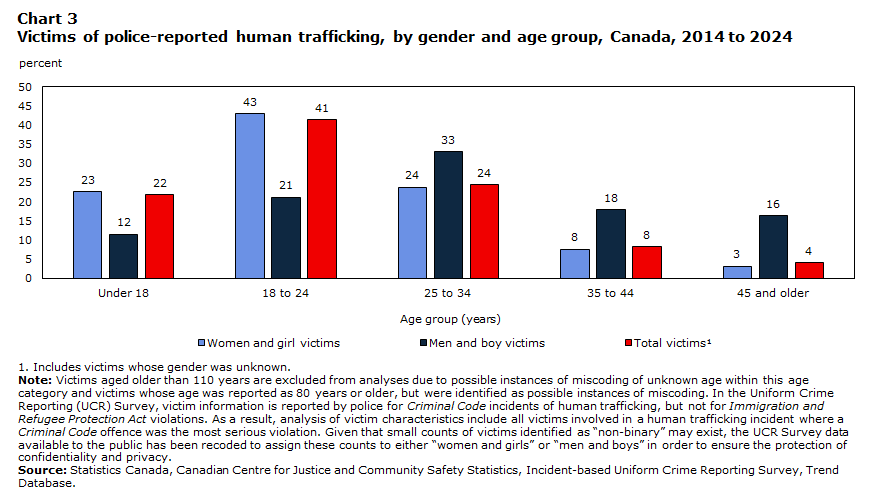
StatCan said that about two in five human trafficking incidents are most commonly related to the sex trade. Bad actors take advantage of vulnerable people — like migrants, youth in care, Indigenous women and girls, and those experiencing poverty.
Halifax in particular was mentioned in the report, which notes that 6.4 per cent of Canada’s incidents were reported in the provincial capital. In 2024, StatCan said the highest rate of human trafficking was reported by police in Guelph (11 per 100,000), followed by Halifax (7.5 per 100,000).
“If people are suffering across the province and they’re looking for opportunities to move on to a different point in their life, to get whatever it is that this trafficker is promising…That sounds great when you’re coming from maybe an area of the province where you don’t have those opportunities,” MacFarlane said.